
Making refurbishment count: Better measurement, stronger outcomes
News
- Sustainability
26 November 2026
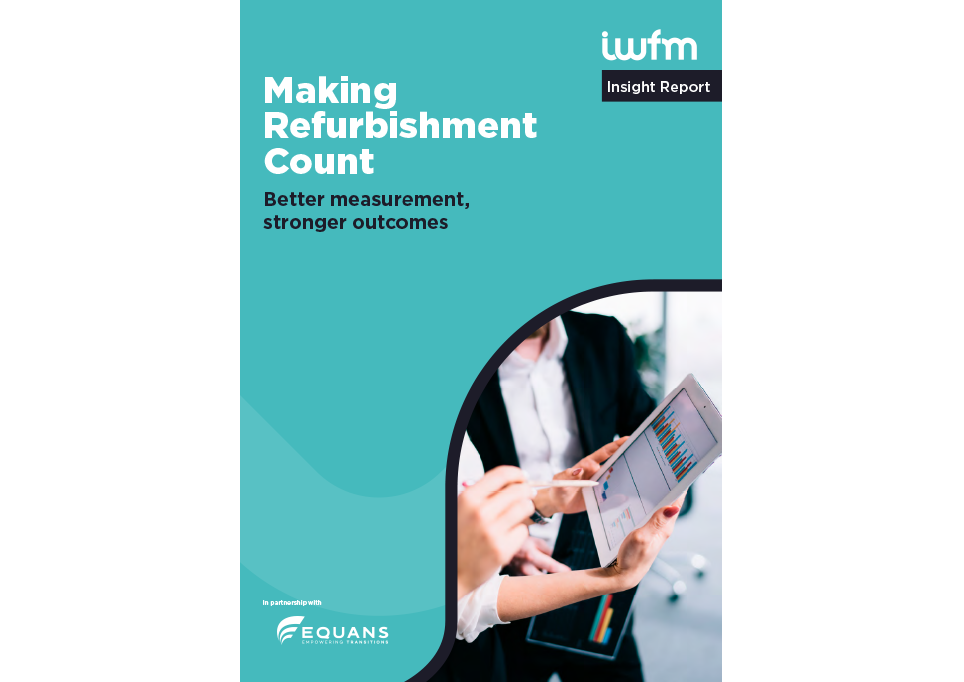
Newly published IWFM research explores how workplace and facilities professionals can make refurbishment and retrofit work harder for their organisations, delivering stronger financial, environmental and workplace outcomes.
Refurbishment and retrofit, done well, can extend the life of buildings and assets, improve energy performance, strengthen resilience and create better workplaces.
But are organisations getting all the value they could from that investment, and can they prove it?
That question sits at the heart of IWFM’s new Sustainability Survey Report 2026, ‘Making refurbishment count: Better measurement, stronger outcomes’, produced in partnership with Equans UK & Ireland.
This year’s research looks at how refurbishment and retrofit projects are being approached, what gets in the way of better outcomes and what distinguishes more successful projects.
Its findings point to a clear opportunity for workplace and facilities management professionals to play a more influential role in shaping investment and demonstrating the value that projects deliver.
From necessary work to strategic opportunity
Much refurbishment and retrofit starts with a practical need. Buildings and assets age, equipment needs replacing and workplaces need to adapt. But these moments provide an opportunity to think more broadly.
Rather than treating interventions in isolation, organisations can consider how planned work could also support energy efficiency, decarbonisation, resilience, asset performance and workplace experience.
As Jenny Thomas, Director of External Affairs, Insight and Impact at IWFM, says: ‘If you can pack more into your refurbishment and retrofit plans, you can boost the ROI and make a much stronger case, and ultimately deliver radical financial and sustainability gains.’
Workplace and facilities professionals are well placed to connect immediate operational requirements with longer-term organisational priorities. The research explores the relationship between FM involvement and successful projects, as well as the approaches that can support better outcomes.
Amelle Mestari, Sustainability & Procurement Director at Equans UK & Ireland, said: ‘Refurbishment gives us a real opportunity to think differently about existing buildings. Rather than simply replacing assets like-for-like when they reach the end of their life, we should ask how that investment can improve energy performance, resilience, the workplace experience and wider sustainability outcomes. Bringing workplace and facilities managers into those decisions early is critical. And if we establish the right baseline and measure what changes, we can demonstrate the financial, environmental and social value of taking that broader approach.’
Making the case for investment
Projects can generate benefits across workplace experience, asset performance, energy use, operational resilience and sustainability. But recognising those benefits is different from being able to evidence them.
The report views measurement as a critical area for improvement.
Clear objectives, good baseline data and effective post-project measurement can help workplace and facilities professionals move beyond saying an intervention worked to showing what changed as a result.
Linda Hausmanis, CEO of IWFM, says: ‘By failing to measure we are failing in our sustainability responsibilities as well as our responsibilities to our employers, our clients and our profession.’
That evidence is especially important when budgets are under pressure. Being able to demonstrate outcomes can strengthen the case for future investment and give decision-makers greater confidence in what refurbishment and retrofit can achieve.
What does good look like?
‘Making refurbishment count: Better measurement, stronger outcomes’ arrives at practical insights to help workplace and facilities professionals answer that question.
It enables readers to compare their organisation’s approach with others, explore the factors associated with successful projects and identify opportunities to strengthen their own refurbishment and retrofit activity.
We examine the different challenges facing parts of the sector and set out recommendations for workplace and FM professionals and service providers.
With earlier involvement, stronger collaboration, better planning and meaningful measurement, workplace and facilities professionals can help turn necessary interventions into investments that deliver lasting value.
Download ‘Making refurbishment count: Better measurement, stronger outcomes’ to explore the findings, benchmark your approach and identify practical steps towards stronger refurbishment and retrofit outcomes.
Sustainability Survey Report 2026
IWFM’s new Sustainability Survey Report 2026, ‘Making refurbishment count: Better meas...