
New IWFM Good Practice Guide helps workplace and facilities leaders navigate AI with confidence
News
- Technology
16 November 2026

IWFM has launched a new Good Practice Guide to help workplace and facilities professionals make informed, responsible decisions about artificial intelligence, from everyday productivity tools to AI-enabled operational systems.
Artificial intelligence already has its place among many of the tools used to manage information, services, workplaces and assets. For workplace and facilities leaders, it supports informed, responsible decisions about the planning, implementation, governance and assurance of artificial intelligence.
'AI: Leadership, Strategy & Assurance – for workplace and facilities leaders', provides a practical framework for answering that question.
Written by Gordon Mitchell FIWFM, Co-founder of Wholus and Chair of the IWFM Technology Special Interest Group, the guide is designed primarily for workplace and facilities leaders working within strategic roles. Rather than beginning with technology or particular AI products, it starts with the workplace, estate, asset or service outcome that needs to be achieved.
That distinction is important. AI can potentially help improve consistency and quality, create useful capacity, speed up delivery and produce better insight. But these benefits are not automatic. They depend on the purpose for which AI is being used, the information available to it, professional judgment and effective controls.
Start with the decision, not the technology
At the heart of the guide is a straightforward principle: start with the work, not the model.
It encourages leaders to trace an AI-supported activity from the organisational need and source information through to the workflow it affects, the accountable decision, the controls in place and the evidence that will demonstrate whether the intended outcome has actually improved.
For professionals needing a quick starting point, the guide sets out seven core questions covering:
- purpose
- information
- risk
- accountability
- control
- evidence
- improvement.
Together, these provide a practical decision pathway for considering an existing or proposed use of AI with checklists throughout the guide to help readers apply the guidance within their own organisations.
This approach also recognises that not every application carries the same consequences. Using AI to prepare a reversible draft that is reviewed before use is very different from allowing an AI-enabled workflow to alter a record, instruct a supplier or affect a connected building system.
The guide therefore distinguishes between 'contained support', 'managed operational use' and 'consequential or delegated use', helping organisations apply controls that reflect the potential impact of the activity.
From everyday AI to intelligent buildings
It covers the many everyday AI applications such as searching approved information, preparing drafts, classifying service requests and summarising maintenance records, alongside predictive maintenance, digital twins, operational intelligence, intelligent buildings and AI agents capable of using tools or taking actions.
Throughout, the emphasis remains on accountability.
A convincing AI output is not necessarily an accurate or appropriate one. The guide examines how organisations can maintain human oversight, distinguish generated or inferred information from authoritative records and ensure people have the competence, information, time and authority to challenge, change or stop an AI-supported process.
Governance that works in practice
As AI becomes embedded within familiar business systems, organisations may find capabilities becoming available without a standalone AI project or procurement decision.
The guide therefore encourages leaders to understand what is already being used and to integrate AI governance with existing approaches to information management, information security, procurement and contract management, data protection, risk and professional practice.
It also considers issues including bias and fairness, supplier controls, sustainability, life cycle assurance, digital maturity, interoperability, workforce capability and how organisations can maintain services when an AI capability or its dependencies become unavailable.
Importantly, the guide addresses when not to use AI. Where the purpose is unclear, information is unsuitable, accountability cannot be maintained or a simpler approach could meet the need more reliably, deciding against AI can itself be good governance.
Leading AI-enabled change
Ultimately, responsible AI adoption is as much a leadership issue as a technology issue.
Making AI-enabled tools available to employees does not, on its own, constitute an AI strategy. Leaders need to connect investment to organisational and workplace outcomes, information, people and service capability, while establishing how value, risk and learning will be assessed.
That includes considering how work itself may change. AI might remove or accelerate one task while creating additional checking, correction or exception handling elsewhere. The guide encourages organisations to involve the people who perform and rely on the work, understand where professional judgment must remain with people and ensure skills develop alongside technology.
With AI capabilities evolving rapidly, the aim is not to provide a fixed rulebook. Instead, the guide offers a practical basis for asking the right questions, setting appropriate boundaries and adjusting decisions as evidence develops.
'AI: Leadership, Strategy & Assurance – for workplace and facilities leaders' is available now. It’s free to IWFM members / £65 for non-members.
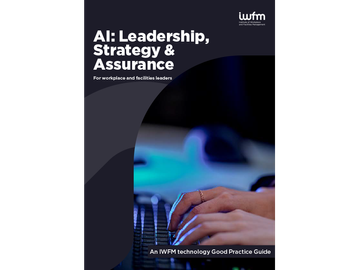
AI Leadership, Strategy & Assurance for Workplace and Facilities Leaders
This Good Practice Guide helps workplace and facilities professionals make informed, r...
And on 3rd December 2026 you can join IWFM’s Strategic Leaders Forum and the Technology Special Interest Group for an event marking the launch of this guide.